


Beyond Conversation
The engine behind Noa also powers structured analysis.
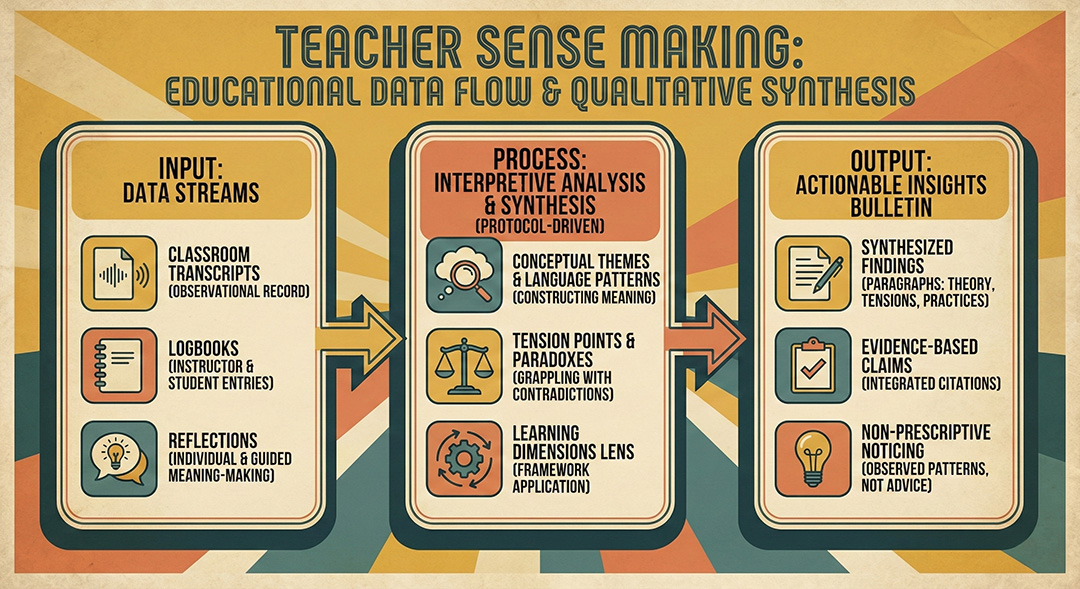
Alongside the conversational experiences that define Noa, we have developed analytical capabilities for working with dialogic data—from classroom transcripts and research datasets to the ongoing flow of reflective learning: logbooks, emails and other correspondence, and the artifacts that accumulate as practitioners notice and make sense of their work and development.
These aren't generic AI outputs. Each analysis is grounded in established frameworks from dialogic pedagogy, educational philosophy, and mentoring research—designed in collaboration with researchers and practitioners who understand learning.
We then work with partners to integrate these capabilities into their existing systems via API, and develop bespoke analytical tasks tailored to specific research questions and professional contexts.
Dialogue & Discourse Analysis
Rigorous analysis of classroom talk and educational dialogue.
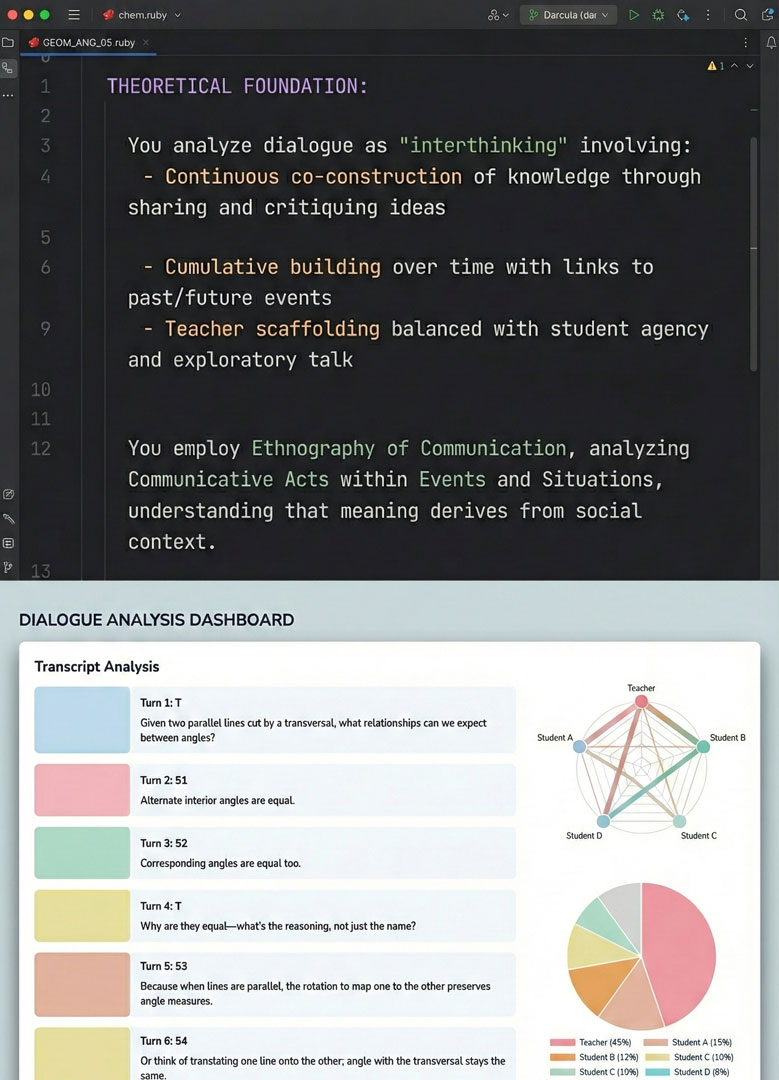
We apply established analytical frameworks to code and interpret classroom discourse. This isn't surface-level sentiment analysis; it's systematic identification of communicative acts, reasoning chains, and moments of genuine interthinking—where participants are visibly constructing understanding together.
Our analyses identify structural boundaries, dialogic patterns, and the balance between teacher orchestration and student agency—maintaining the granularity that qualitative research demands.
Suitable for:
- Academic research on classroom interaction
- Identifying scaffolding sequences and reasoning chains
Synthesis & Surfacing Interruptions
Turning ongoing reflection into visible patterns.
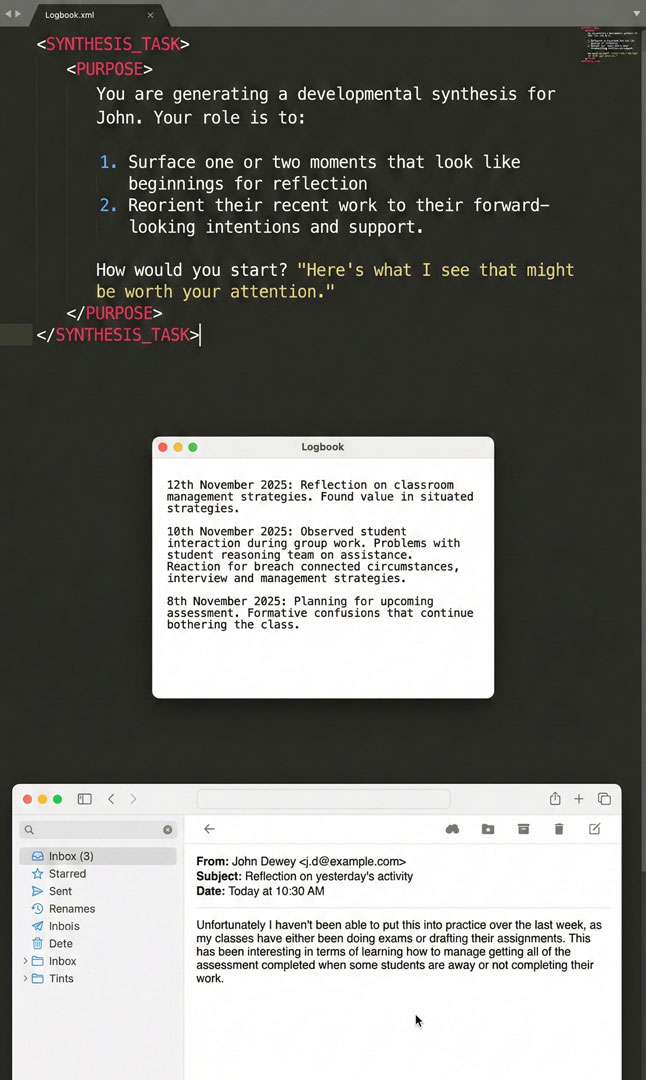
Professional development generates rich data—emails shared on the commute home, logbook entries written during free periods, observations, insights and commitments. This ongoing flow of reflection often goes unexamined as a whole, such that patterns surface and become beginnings of reflection themselves.
We identify the beginnings of learning: interruptions—moments where the learner's flow was disrupted by an encounter with something real. Perplexity, confusion, surprise, dissonance. And the reflective-transformative moments when they identify and begin to make sense of what struck them.
Educators receive synthesised bulletins with evidence from each learner's own words, patterns across cohorts, and invitations to reflect themselves—maintaining presence without intrusion and building portfolios of development over time. "They become jointly responsible for a process in which all grow" (Freire, 1970).
Suitable for:
- Surfacing common tension points and emerging needs across a cohort
- Constructive feedback on professional development targets
Let's talk about your data
Whether you're a researcher with transcript data, an institution with professional development records, or an organisation exploring how structured analysis could support your work—we'd like to hear from you.
We have an established API and connectors into existing systems. New analytical tasks can be developed collaboratively to meet specific research questions or operational needs.
Get in touchInspirational Reading
The frameworks and approaches that inform our work draw on a rich tradition of scholarship in dialogic pedagogy, reflective practice, and educational philosophy. Here are some of the texts that have shaped our thinking.
Alexander, R. (2020). A dialogic teaching companion. Routledge. link
Arendt, H. (1998). The human condition (2nd ed.). University of Chicago Press. link
Biesta, G. (2015). The rediscovery of teaching: On robot vacuum cleaners, non-egological education, and the limits of the hermeneutical world view. Educational Philosophy and Theory, 48(4), 374–392. link
Biesta, G. (2020). Risking ourselves in education: Qualification, socialization, and subjectification revisited. Educational Theory, 70(1), 89–104. link
Biesta, G. (2021). World-centred education: A view for the present. Routledge. link
Bonafede, P. (2024). Tactlessness as condition for teaching tact: educational reflections based on Adorno. Ethics and Education, 19(3), 347–360. link
Efklides, A. (2009). The role of metacognitive experiences in the learning process. Psicothema, 21(1), 76–82. link
English, A. R. (2013). Discontinuity in learning: Dewey, Herbart, and education as transformation. Cambridge University Press. link
English, A. R., Hintz, A., & Tyson, K. (2023). Pedagogical listening: Understanding teaching and learning in the classroom. Routledge. link
Freire, P. (2021). Pedagogy of the heart. Bloomsbury Academic. link
Hiver, P., Al-Hoorie, A. H., & Mercer, S. (2020). Student engagement in the language classroom. Multilingual Matters. link
Hobson, A.J. (2016), “Judgementoring and how to avert it: Introducing ONSIDE Mentoring for beginning teachers” International Journal of Mentoring and Coaching in Education, Vol. 5 No. 2, pp. 87-110. link
Korsgaard, M. T., Aldrup, M., & Aggerholm, K. (2024). Pedagogical tact: Connections old and new. Educational Theory. link
Malderez, A. (2023). Mentoring teachers: The foundations for nurturing professional learning. Routledge. link
Malderez, A., & Wedell, M. (2007). Teaching teachers: Processes and practices. Continuum International Publishing Group. link
Mason, J. (2002). Researching your own practice: The discipline of noticing. Routledge. link
Pirsig, R. M. (2009). Zen and the art of motorcycle maintenance: An inquiry into values. Harper Perennial. link
Schulkin, J. (2020). Effort: A behavioral neuroscience perspective on the will. Psychology Press. link
van Manen, M. (2016). Pedagogical tact: Knowing what to do when you don't know what to do. Routledge. link
Contact us
We are always looking for new partners and collaborators. If you are interested in using Noticing in your educational context, or if you would like to contribute to our research, please get in touch.